Overview
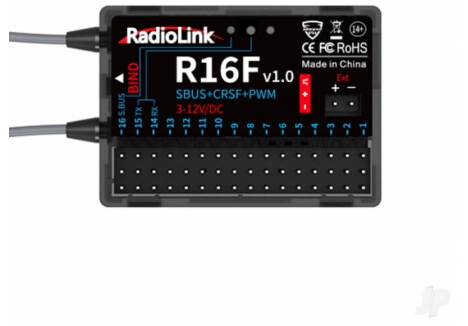
The RadioLink R16F is a professional-grade 16-channel 2.4GHz receiver that represents outstanding value for RC enthusiasts across the UK. Whether you're piloting a high-performance RC car, flying a multicopter, controlling a boat, or managing a glider, this compact receiver delivers reliable signal transmission and versatile control options that will satisfy both beginners and experienced pilots alike. With its support for multiple signal protocols—PWM, S.Bus, and CRSF—the R16F adapts seamlessly to virtually any modern RC system, making it an essential component for anyone serious about their RC hobby.
What sets the RadioLink R16F apart from competitors is its combination of advanced features in a remarkably compact form factor. At just 35.6mm long, 25mm wide, and 14mm tall, weighing only 11.8 grams, this receiver is small enough to fit into the tightest airframes and chassis whilst maintaining the robustness required for serious RC use. The dual-antenna design ensures dependable link performance across varied operating conditions, whilst the 2.4GHz ISM frequency band with 67-channel pseudo-random frequency hopping technology provides secure, interference-free communication with compatible RadioLink transmitters.
Whether you're building a custom RC setup or upgrading an existing system, the R16F offers exceptional compatibility, flexibility, and reliability at a price point that makes it accessible to hobbyists at every level. The receiver's firmware upgrade capability via USB Type-C means you can access cutting-edge new functions without purchasing additional hardware, keeping your equipment current as your hobby evolves.
Key Features
- 16-Channel Multi-Protocol Support — The R16F outputs 16 channels of control data, and supports three different signal output formats simultaneously: PWM (traditional pulse-width modulation), S.Bus (serial protocol), and CRSF (Crossfire protocol). This flexibility means the receiver will work with almost any modern ESC, servo, flight controller, or other RC component you might connect to it, making it one of the most versatile receivers available on the market today.
- 2.4GHz FHSS Frequency-Hopping Technology — Operating on the 2.4GHz ISM band with 67 channels of pseudo-random frequency hopping, the R16F uses the same proven RadioLink FHSS spread-spectrum technology found in professional RC systems worldwide. This intelligent frequency-hopping approach automatically avoids interference from WiFi, Bluetooth, and other 2.4GHz devices, ensuring rock-solid signal stability even in crowded RF environments.
- Dual Antenna Design — The receiver features dual antennas (one coaxial cable antenna and one external antenna approximately 4-5 centimetres long) that work together to maintain consistent signal reception. Proper antenna installation is critical for optimal range and reliability, and the included guidance on antenna positioning ensures you get maximum performance from your receiver.
- Wide Voltage Operating Range — The R16F operates on any voltage between 3V and 12V DC, providing exceptional flexibility for different applications. Whether you're powering it with a single 2S LiPo battery (which produces 7.4V nominal), a traditional nickel-metal hydride pack, or even a 12V system in larger RC vehicles, the receiver will function reliably without damage or malfunction.
- Multiple Output Modes — The receiver can operate in four distinct modes: pure PWM output (12 channels), PWM+S.Bus combination, PWM+CRSF combination, or all three protocols simultaneously. Each mode is selected by pressing the binding button a specific number of times, with status indicated by colour-coded LED lights (red for PWM, blue for S.Bus, green for CRSF), making configuration straightforward and intuitive.
- FHSS Protocol Options — The R16F supports three different RadioLink FHSS protocols (V1, V2, and V2.1), each offering different advantages. FHSS V2.1 protocol is the most advanced, offering 4096-level PWM resolution (compared to 2048 in FHSS V1) and selectable servo response times of 3ms, 4ms, or 14ms, delivering the precision and responsiveness demanded by modern RC pilots.
- Firmware Upgrade Capability — Unlike receivers that become obsolete, the R16F can be updated with new firmware via a simple USB Type-C connection to your computer. Simply hold the binding button whilst connecting the receiver to your PC, and new functionality will be added automatically, ensuring your receiver stays current with the latest RadioLink innovations.
- Quick Binding Process — Binding the R16F to a compatible transmitter takes just seconds: power on the transmitter and receiver at close range, press the black ID SET binding button for one second, and wait for the LED to stop flashing. This secure bind process creates an individual ID code unique to your receiver and transmitter pair, preventing accidental interference from other RC systems nearby.
- Telemetry Capability — The R16F is telemetry-enabled, allowing it to send signal strength information (RSSI - Received Signal Strength Indicator) back to your transmitter. This invaluable feedback lets you monitor signal quality in real-time and diagnose RF issues if needed, providing confidence that your control link is solid.
- Reverse Polarity Protection — Built-in protection against incorrect power connection prevents damage to the receiver's sensitive electronics if you accidentally reverse the battery leads, adding an extra layer of reliability and peace of mind.
- Compact, Lightweight Design — Weighing just 11.8 grams with dimensions of 35.6 x 25 x 14mm, the R16F is small enough to integrate into compact RC models without adding noticeable weight or requiring significant space considerations, yet robust enough for demanding applications.
Technical Performance
The RadioLink R16F is engineered to deliver professional-grade performance in a package that's accessible to RC hobbyists of all skill levels. Operating across the 2.4GHz frequency band (2400-2483.5MHz specifically), the receiver achieves an impressive maximum control range of 4000 metres in the air under ideal conditions—though realistic operating range will be lower in urban environments with interference and obstructions. The receiver draws approximately 37 milliamps at 5V, making it efficient enough for battery-powered applications whilst delivering full functionality. The 205mm antenna ensures proper signal reception when installed correctly, and the receiver operates reliably across an extremely wide temperature range from -30°C to +85°C, making it suitable for use in extreme climates from arctic expeditions to desert racing. The response latency can be configured at 3, 4, or 14 milliseconds depending on the protocol selected and your application requirements—for FPV racing and aggressive flying, the 3ms option provides maximum responsiveness, whilst 14ms is suitable for slower applications like gliders or giant scale models where bandwidth conservation is important. The robust construction, with precision-engineered circuit boards and quality components throughout, ensures this receiver will provide years of reliable service.
Compatible Transmitters
The RadioLink R16F is compatible with the following RadioLink transmitter models: T16D, T12D, T8FB, T8S, RC8X, RC6GS V3, RC4GS V3, RC6GS V2, RC4GS V2, RC6GS, and RC4GS. If you're using a T16D or T12D transmitter, you'll need to select the appropriate receiver protocol in the transmitter's RF Settings menu before binding—the R16F supports FHSS V1 (8 channels maximum), FHSS V2 (8 channels, higher resolution), and FHSS V2.1 (16 channels, highest resolution). RadioLink recommends using FHSS V2.1 protocol for the best performance and full 16-channel capability. After selecting the protocol, you must rebind the receiver and transmitter for the new protocol to take effect.
Antenna Installation and Signal Optimisation
Proper antenna installation is absolutely critical for achieving the range and reliability the R16F is capable of delivering. The receiver includes one antenna permanently attached as a coaxial cable and a separate external antenna (the transparent plastic line approximately 4-5cm long) that must be protected from damage, as any breakage will severely degrade signal reception. When installing the receiver in your model, observe these essential guidelines: position antennas vertically or perpendicular to the ground rather than parallel to it, keep antennas away from metal objects and conductive materials (including carbon fibre) by at least half an inch as reflections degrade signal quality, avoid placing antennas near high-power components like motors and ESCs that generate electromagnetic interference, and use foam or rubber vibration-dampening material when mounting the receiver to protect the sensitive electronics. For larger models containing significant metal structures, mounting antennas on opposite sides of the model ensures consistent signal in all orientations. Never bend the antennas excessively, and always keep the receiver stored in a sealed plastic bag when not in use to protect it from moisture and dust.
Setup and Operation
Getting your R16F up and running involves a few straightforward steps. First, you'll bind the receiver to your transmitter: place them about 30cm apart, power on both units, and press the black binding button on the receiver for more than one second. The LED will flash rapidly whilst binding is in progress, then become solid when complete—a signal tower will appear on your transmitter's display confirming successful binding. Next, you'll configure the operating mode by pressing the binding button: a single short press enables or disables S.Bus output (indicated by blue LED), whilst two rapid presses within two seconds toggle CRSF mode (indicated by green LED). The red LED indicates PWM mode, which is always active. Once configured, the receiver is ready to use with any compatible servo or ESC connected to the appropriate channel outputs.
RSSI Testing and Diagnostics
To verify that your receiver is functioning optimally, the R16F provides RSSI (Received Signal Strength Indicator) testing capability through your transmitter. Power on both the transmitter and receiver and confirm they're bound by checking for a signal tower on the transmitter display. Make sure the antennas are properly aligned (parallel to each other) and held about 30cm apart vertically. The RSSI value displayed should be between 0 and -30dBm, with values closer to zero indicating stronger signals. Abnormal signal strength values (weaker than expected) are most commonly caused by damaged antennas, so visually inspect both the receiver's antennas and your transmitter's antenna for any visible breakage or damage. If antennas appear intact but signal remains weak, try testing with a different receiver to isolate whether the problem is with the original receiver or the transmitter.
What's in the Box
- RadioLink R16F 16-channel receiver (1 unit)
- Coaxial cable antenna (integrated, approximately 205mm length)
- External antenna (approximately 4-5cm transparent plastic rod)
What You Need to Complete
- Compatible RadioLink transmitter (T16D, T12D, T8FB, T8S, RC8X, RC6GS V3/V2, or RC4GS V3/V2)
- Power source: LiPo battery, NiMH battery, or power supply capable of delivering 3-12V DC
- Servo(s) or ESC(s) compatible with PWM, S.Bus, or CRSF signal input
- USB Type-C cable (only required if updating receiver firmware)
Frequently Asked Questions
- What is the difference between the RadioLink R16F and the R12F receiver? — The R16F supports full 16-channel operation with FHSS V2.1 protocol, whilst the R12F is limited to 12 channels and 8 channels with FHSS V1 protocol. The R16F also features dual antennas for improved signal stability. Both receivers support PWM, S.Bus, and CRSF outputs, but the R16F provides double the channel capacity for more complex applications.
- Is the RadioLink R16F suitable for beginners? — Yes, absolutely. Whilst the R16F is a professional-grade receiver with advanced features, its straightforward binding process, colour-coded LED status indicators, and simple mode-switching make it very user-friendly. Beginners benefit from the receiver's versatility as they can start with basic PWM servo control and gradually explore more advanced S.Bus and CRSF capabilities as they develop their skills.
- What voltage does the R16F need? — The receiver operates reliably on any voltage between 3V and 12V DC. This means it can be powered by: a 2S LiPo battery (7.4V nominal), a 3S LiPo (11.1V nominal), traditional nickel-metal hydride packs, or even lead-acid batteries. Always verify your power source stays within the 3-12V range to avoid damage.
- Can I use the R16F with non-RadioLink transmitters? — No, the R16F is designed specifically for RadioLink transmitters and is not compatible with other brands such as Spektrum, Futaba, or Frsky. You must use one of the compatible RadioLink transmitter models listed in the product specifications.
- How do I update the R16F firmware? — Connect the receiver to your computer using a USB Type-C cable. Press and hold the binding button whilst plugging the cable in, then release the button. The receiver will appear as a USB flash drive on your computer—copy the latest firmware file to this drive to complete the update. New firmware adds cutting-edge features without requiring any additional hardware.
- What is the maximum range of the R16F? — Under ideal conditions in an unobstructed area free of interference, the R16F achieves a maximum range of 4000 metres. Real-world range in urban environments, near buildings, trees, and around other RF sources will typically be lower—expect 500-1500 metres depending on local interference levels and antenna installation quality.
- Why is antenna installation important? — The receiver's antenna directly determines signal quality and range. Antennas must be positioned vertically (perpendicular to the ground) to maximise reception, kept away from metal objects and conductive materials, and protected from damage. Poor antenna installation or damaged antennas are the most common cause of short-range problems and signal dropouts.
- Can I bind multiple receivers to one transmitter? — Yes, RadioLink transmitters support multiple binds using the Subsidiary ID feature. This allows you to bind several receivers to the same transmitter and switch between them using a designated function, perfect for operating multiple models from one controller.
- What's the difference between PWM, S.Bus, and CRSF output modes? — PWM (pulse-width modulation) is the traditional output format, with each channel using a separate wire—the R16F provides 12 channels of PWM. S.Bus is a serial protocol that transmits all channels through a single wire, saving wiring and space. CRSF (Crossfire protocol) is the most modern format, offering extremely fast response times and telemetry feedback. The R16F can output all three formats simultaneously in different modes.
- How long does binding take? — Binding typically takes just a few seconds. After pressing the binding button for one second, the LED will flash rapidly for a moment, then become solid when binding is complete. Total time from button press to finished bind is usually under 5 seconds.
- Is the R16F waterproof? — Whilst the receiver doesn't have a specific IPx waterproof rating, it features precision electronics that are vulnerable to moisture. For water-exposed applications, keep the receiver in a sealed plastic bag inside your model. The receiver should not be submersed in water or exposed to heavy rain during operation.
- What does RSSI testing do? — RSSI (Received Signal Strength Indicator) testing lets you verify that your receiver is getting a strong, clean signal from the transmitter. RSSI values between 0 and -30dBm indicate good signal strength. Weak RSSI values suggest antenna problems or environmental interference that should be investigated before flying or operating your model.
Why Buy from RC Model Shop?
RC Model Shop is a trusted UK RC retailer and authorised dealer for all the brands we stock, including Traxxas, ARRMA, Losi, FTX, Hobbywing, Spektrum and more. Based in Walsall, we have a physical store where customers are welcome to come in, view products and purchase in store. Whether you are a seasoned competitor, a weekend basher, or just discovering the world of RC for the first time, our team of experienced RC enthusiasts is here to help you find the perfect setup and provide ongoing support. Order the RadioLink R16F 2.4GHz 16-channel, PWM, S.Bus & CRFS Receiver RLKR081011 today with confidence, knowing you are buying from an authorised retailer with genuine products, expert knowledge and a commitment to customer satisfaction. Shop online or visit us in Walsall — we look forward to helping you get the most out of your RC experience.